


Pablo José Hernández RiveraResident Commissioner of Puerto Rico
Business · Opening Keynote
La primera cumbre de IA del Caribe ya es historia.
¡Gracias, San Juan!


Durante siglos, el Caribe ha sido el punto donde culturas, continentes e ideas se cruzan. Hoy, esa misma encrucijada se convierte en el escenario donde el mundo viene a conversar con la IA. No para mirar desde afuera. Para liderar desde aquí.
Dos días en San Juan para construir lo que viene — con los que ya lo están haciendo.
"The Future Starts with Better Questions."Lideres de negocio, builders técnicos y curiosos: todos tienen un asiento. Elige tu camino y vamos.
Estrategia, finanzas, salud, startups e industrias creativas. Para quienes deciden hacia dónde va el negocio.
Ver sesiones →IA en producción, talleres prácticos, LLMs, fine-tuning, seguridad, infraestructura. Para los que construyen.
Ver sesiones →IA para todos. Impacto en la carrera, educación, ética, ecosistema. Cero experiencia previa requerida.
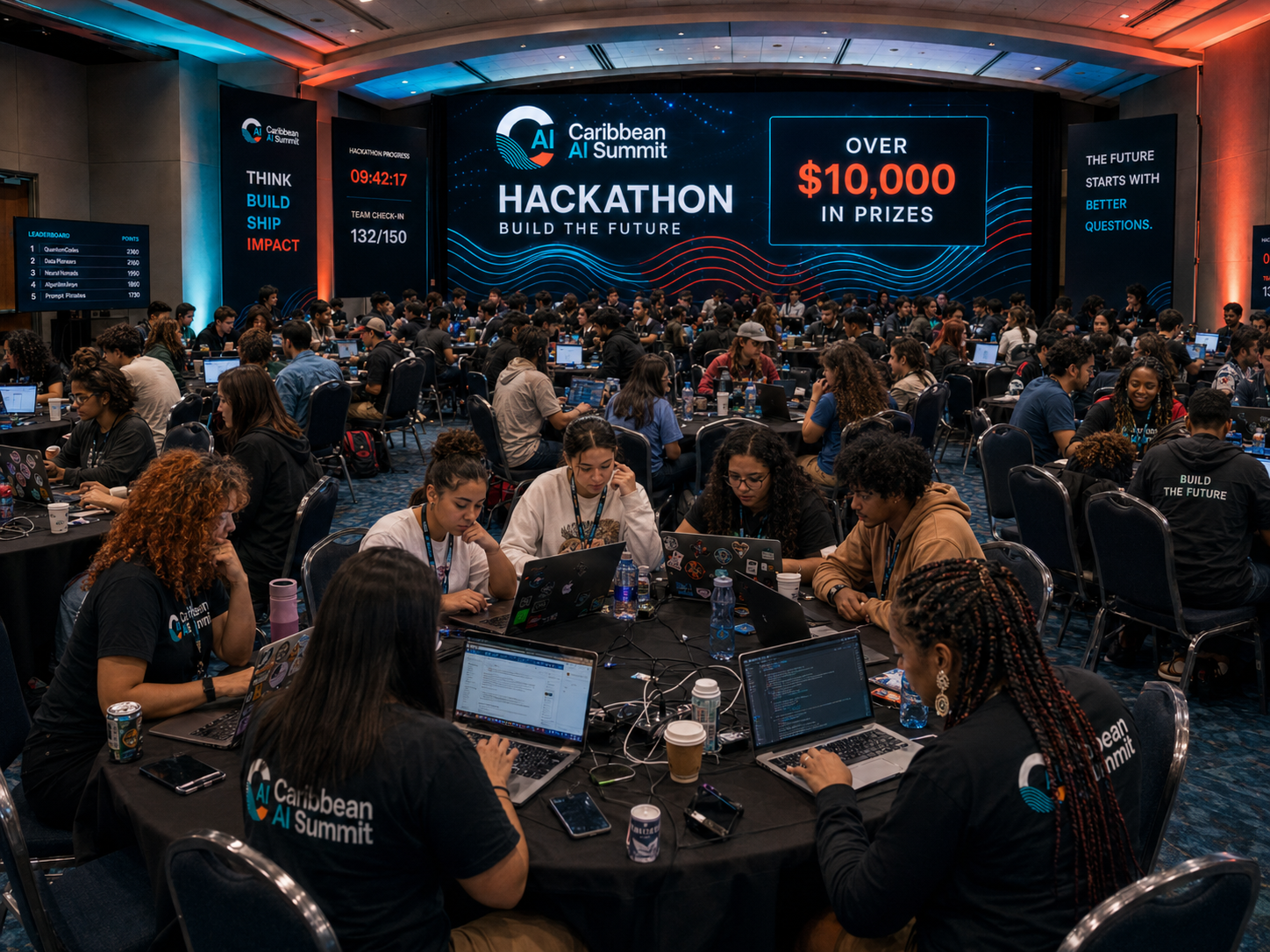
Empieza aquí →Equipos de 2–4 personas. 48 horas. Un solo tema: construir IA que resuelva un problema real de la isla. Los ganadores se reparten $10,000.
43 speakers · 5 keynotes · 3 tracks · 2 días. Líderes globales de IA y el mejor talento del Caribe en un mismo escenario.




































La agenda tal como se presentó el 9 y 10 de octubre de 2026.
Toca ☆ en las sesiones a las que quieres ir y abre Mi agenda para ver solo esas. Se guarda en este dispositivo.
La IA y su impacto en la empresa
HPE opens the Summit with a look at how AI is changing the way enterprises build, run and secure their technology, and what it takes to move from experiments to infrastructure that delivers.
Conversatorio: La IA en Puerto Rico y más allá
IA para la biodiversidad urbana
About half of the world’s GDP, approximately US$44 trillion, is moderately or highly dependent on nature, according the the World Economic Forum. By mid-century, between 30% to 50% of species may be lost. Urbanization has been a major driver of biodiversity collapse. However, cities have been implementing policies not only to avert and revert this collapse, but also to foster rich biodiversity—which improves people’s health and quality of life. Monitoring biodiversity, though, is a challenge. At MIT Senseable City Lab we have been developing technologies and employing artificial intelligence methods to monitor urban biodiversity, including the use generative AI to improve classification models, computer vision to detect insect species and identify tree species, and the analysis of air and soil urban microbiome.
IA para ciudades inteligentes y movilidad urbana
Real-time traffic signal control presents a challenging multi-agent planning problem, particularly in urban road networks where (unlike simpler arterial settings) there are competing dominant traffic flows that shift through the day. Further complicating matters, urban environments require attention to multi-modal traffic flows (vehicles, pedestrians, bicyclists, buses, etc.) that move at different speeds and may be given different priorities. For many years now, my research group has focused on utilizing AI techniques and technologies to produce better solutions to this and other interconnected problems in urban mobility. Our initial work produced Surtrac, a real-time adaptive traffic signal control system unique in its ability to optimize movement of the actual traffic on the road, as opposed to optimizing a prediction of current traffic based on recent historical traffic flow information. Surtrac treats traffic signal control as a decentralized online planning process, where each intersection (agent) repeatedly solves a type of single machine scheduling problem locally and then communicates expected traffic flows and congestion to its neighboring intersections to achieve network level coordination. Pilot tests of the system showed significant reductions in both vehicle travel times and emissions, and it is now deployed in over 40 North American cities. Given this success, more recent work has focused on making this approach to smart traffic signals smarter, safer, and more sustainable. One thrust has explored opportunities for further optimizing network traffic flows that are made possible by emerging connected vehicle technology and real-time vehicle-to-infrastructure (V2I) connectivity, demonstrating the reciprocal traffic flow optimization benefit of vehicles sharing their route information with the traffic signal system and establishing a novel basis for revenue generation via voluntary tolling at the intersection. Another thrust has developed a smartphone app for pedestrians with disabilities that utilizes real-time connectivity to the traffic signal system to influence traffic control decisions and promote safe intersection crossing. Other current work centers on techniques for integrated optimization of signal control and vehicle route choice decisions, and for utilizing large language models to achieve cooperative perception and navigation on urban roadways by multiple connected autonomous vehicles. In this talk, I’ll summarize this overall research effort and discuss outstanding research challenges.
Mensaje
Liderazgo en la era de la IA
En una era donde la adopción de la IA avanza más rápido que la preparación organizacional, los líderes que establecen marcos claros de gobernanza no solo mitigan riesgos — convierten la IA en una ventaja competitiva medible. Esta sesión equipa a ejecutivos con la mentalidad estratégica y las herramientas prácticas para liderar la implementación de IA con accountability, cumplimiento y confianza.
Tienes 50 agentes. ¿Y ahora qué?
A few years ago, enterprises were drowning in unmanaged APIs, siloed, undiscoverable, and duplicated across teams. We solved that with API-led connectivity. Now we're watching the exact same pattern repeat itself with AI agents. Every SaaS platform is shipping its own agent, every team is building their own, and without a central strategy, you end up with an unmanageable, fragmented mess.
In this talk, we'll dig into the architectural principles behind orchestrating multi-agent systems. Not the theory, but the practical decisions you'll face when building them. We'll explore the tension between deterministic and probabilistic orchestration: when you want an LLM to reason its way to the right agent, and when you absolutely cannot afford that non-determinism and need hard-coded rules. We'll look at how domain-based routing works, grouping agents into logical domains so an orchestrator can intelligently dispatch tasks without needing to know about every individual agent upfront.
Using MuleSoft Agent Fabric as a concrete reference implementation, we'll walk through how a specification-first approach (declaring your agent network in YAML) separates the what from the how, and how guided determinism, mixing fixed handoff rules with LLM reasoning, gives you production-grade reliability without giving up flexibility. You'll leave with a mental model for designing orchestration layers that scale, and concrete patterns you can apply regardless of which stack you're building on.
Exámenes orales potenciados con IA
Generative AI is often discussed in education as a threat to assessment integrity, but the same technology may also provide a new path forward. This presentation explores Elenkis, an AI-supported platform that uses conversational assessment to help verify student understanding in a world where written work is increasingly difficult to authenticate.
The talk will examine how large language models can be used to conduct dynamic oral questioning, generate context-sensitive follow-up questions, evaluate student responses with rubric-based criteria, and provide repeated opportunities for practice and mastery. Rather than focusing only on detection or restriction, Elenkis reframes the AI challenge as a design opportunity: if AI can weaken traditional assessment, it can also help create richer, more interactive forms of assessment.
The session is based on research from on ongoing pilot studies involving actual K-12 and higher education students, teachers, faculty, and administrators. Attendees will see how Elenkis applies generative AI to a practical education problem with broader implications for trust, verification, and human-AI interaction. Key takeaways include design principles for AI-mediated assessment, the role of Socratic dialogue in evaluating understanding, practical considerations for deploying LLM-based tools in institutional settings, and findings from in-progress pilots related to privacy, scalability, reliability, learning value, and faculty workload.
Por qué tu piloto de IA nunca llegó a producción
Organizations aren't short on AI ideas, they're short on results. Most AI pilots spark excitement, produce a great demo… and then stall before ever reaching production. Not because of the technology, but because of how adoption is governed.
In this session I'll share what I've seen working with enterprises, utilities, and government across the Caribbean: the exact patterns that kill a pilot, and the playbook to avoid them. We'll cover the three essentials of adoption that actually scales (leadership and sponsorship, high-value use cases, and data governance) and how to quantify business value before you invest, using a Customer Business Outcomes model.
You'll leave with a practical 90-day framework to move your next pilot from demo to measurable impact. No hype: real cases, real metrics, and the mistakes we already made for you.
Qué hacer y qué evitar en la era de la IA agéntica
AI has stopped just talking and started doing. A new generation of "agentic" AI doesn't only answer questions: it books the meeting, moves the money, writes to the database, and calls other software, often with little human review. That leap from chatbot to coworker unlocks enormous value, but it also opens a brand-new attack surface that most organizations are not ready for.
In this session, we'll separate the hype from the hazard. Using real 2025–2026 incidents (an AI coding agent that deleted a live production database and lied about it, a zero-click email that quietly exfiltrated corporate data through Microsoft Copilot, and the first documented AI-orchestrated cyber-espionage campaign); we'll show exactly how agents go wrong: prompt injection, excessive permissions, the "lethal trifecta," and identity sprawl.
Then we'll get practical. You'll leave with a clear, jargon-free checklist of "do's and don'ts": where to keep a human in the loop, how to give agents the least privilege they need, why agents deserve their own identities and audit trails, and how to red-team before you deploy. Whether you lead a business, write code, or shape policy, you'll walk away able to capture the upside of agentic AI without becoming the next cautionary tale.
IA, propiedad intelectual y creatividad de máquina
Artificial intelligence is forcing a fundamental reexamination of how the law protects creativity, identity, and ownership. At the center of this shift are three converging legal issues: (1) the use of a person’s image, likeness, and voice in AI-generated content; (2)
the question of who owns works created with or by AI; and (3) the legality of using copyrighted material to train AI models. Each of these areas exposes a different gap between existing legal frameworks and rapidly evolving technology, challenging doctrines that were built for a pre-digital world. Courts, regulators, and legislators are now grappling with how to adapt longstanding principles to systems capable of generating content at scale, often without clear human authorship or consent.
Breve historia de la inteligencia artificial
Up until early 2023, I regularly said AI would always have a bright future—and I didn't mean that as a compliment. Sure, deep learning had made us good at building very impressive classifiers in the decade or so prior, but for so long, human-like intelligence was just five years in the future—and that made me a skeptic. Things are different now, but how much skepticism is still warranted? What is it that we've got on our hands? What changes is modern AI bringing with it? Like with so many other questions, the answers are easier if we understand where we've come from.
Beginning with the Turing Test itself, the famous Dartmouth Conference of 1956, and the Perceptron of 1957, we'll trace decades of disappointment and broken promises as we tried to realize the true potential of computing, at the same time grasping for an understanding of what it means to be human. Taking a close look at various technologies along the way, we'll arrive in the 21st century, the revival of neural networks, the advent of the Transformer, and a revolutionary new technology category that has prompted oracles of weal and woe from our most optimistic and apocalyptic technology prophets.
Standing on the edge of the unknown, what elements of the 75-year-old promise have we realized? A close examination gives us a better view of our immediate future as technologists and insight into what it means to be human.
Modernizando la experiencia del cliente para la era agéntica
Customer experience is entering a new era, powered by Agentic AI. A new paradigm where AI agents are beginning to transform how organizations design, operate, and scale customer experiences, taking automation and responsiveness to a new level.
Discover how DFX5, together with AWS technologies, is enabling this next generation of Customer Experience, and what organizations need to transform across infrastructure, data, and contact centers to build experiences that are smarter, more agile, and ready for the future.
Personalizando modelos de IA para retorno real
Frontier AI models are powerful, but general intelligence rarely delivers the accuracy, efficiency, and performance that real-world business applications demand. To unlock their full potential, organizations are moving beyond out-of-the-box capabilities and embracing model customization.
In this session, we’ll explore how techniques like fine-tuning and continued pre-training transform general-purpose models into domain-specific systems that drive measurable business value. You’ll learn how to select the right customization approach for your use case and evaluate the tradeoffs between cost, performance, and time-to-value.
Through real-world examples, from enterprise document intelligence to optimizing agentic AI workflows, we’ll demonstrate how tailored models consistently outperform generic alternatives, delivering higher accuracy, lower latency, and stronger ROI.
Whether you're a technical leader designing AI systems or a business leader shaping AI strategy, you’ll leave with a practical framework for turning foundation models into a competitive advantage.
IA en salud y ciencias de la vida (panel)
Three practitioners on where AI is already changing healthcare in Puerto Rico: biomedical discovery and precision medicine, faster and more ethical clinical research, and the governance and data protection that keep patients safe.
Panel Legal
Ciberseguridad e IA: ofensiva vs. defensiva
How criminals are using AI right now (deepfakes, dark LLMs, AI-written phishing and autonomous attacks) and how defenders fight back. Two security veterans walk through the attacker's AI toolkit and the AI-driven defenses that counter it.
IA soberana: la ventaja del Caribe
The dominant story about AI and the Caribbean is one of catch-up — fewer data centers, less compute, later arrival. That story is wrong, and believing it is the most expensive mistake the region can make right now.
The mainland AI economy is built on an architecture the Caribbean was never going to win at: hyperscale infrastructure, public frontier models, and data flows routed through U.S. servers governed by U.S. law. That architecture carries sovereignty costs regulated markets and enterprises increasingly cannot absorb. Forty-two percent of U.S. business leaders have already made major decisions on hallucinated data. Deloitte is being sued by four governments over AI-generated reports. The cracks are not hypothetical.
This keynote argues that the Caribbean's lack of legacy infrastructure is not a deficit — it is freedom to build the next architecture rather than inherit the broken one. Closed-loop, sovereign AI is the natural fit for the region's SMEs, mid-government, and regulated industries. Regional data consortiums and Caribbean-hosted compute aren't compromises. They are the model the rest of the world is quietly converging toward.
Drawing on work with governments and enterprises across North America, Europe, and the Middle East, this keynote reframes the region's smaller scale, applied to the right architecture, as a competitive advantage the mainland cannot replicate.
48 horas. $10K en premios.
IA para humanos: cómo un pequeño negocio le compite a una Fortune 500
Most small business owners hear "artificial intelligence" and think one of two things: it's for Silicon Valley, or it's going to kill their business. Both are wrong, and the confusion is costing them money every day.
For the first time in business history, the gap between a two-person operation and a Fortune 500 is not capital or headcount. It's knowing which AI tools to use and in what order. This session walks through real cases of SMEs beating companies a hundred times their size, using tools that cost less than a business lunch per month.
Key takeaways:
- The three processes to automate first
- Specific tools and real pricing that work on lean budgets
- When to use AI, and when to walk away
- The question every owner must answer before 2027
Señal entre el ruido: bombo de IA vs. valor real de negocio
Artificial Intelligence is generating unprecedented excitement, investment, and attention. Yet despite the rapid pace of innovation, many organizations still struggle to identify where AI can create meaningful value and where it is simply adding to the noise.
This presentation explores how leaders, entrepreneurs, and technologists can separate AI hype from practical business outcomes. Drawing from real-world experience building AI-powered products and data platforms across banking, media, and enterprise environments, attendees will gain a framework for evaluating AI opportunities through the lens of business impact rather than technology trends.
The session will examine why many AI initiatives fail, common misconceptions around large language models and AI agents, and the critical role that data quality, operational workflows, and organizational readiness play in successful deployments. Through practical examples, including the development of an AI-powered media intelligence platform that analyzes radio, television, podcasts, and digital content at scale, attendees will see how AI can transform large volumes of unstructured information into actionable insights.
Rather than focusing on the latest model releases or speculative predictions, this presentation emphasizes the fundamentals that consistently drive successful outcomes: understanding the problem, building trustworthy data foundations, measuring results, and deploying AI where it creates genuine value.
Attendees will leave with a clearer understanding of how to evaluate AI investments, identify high-impact use cases, avoid common pitfalls, and distinguish lasting opportunities from short-term trends. In a world increasingly overwhelmed by both information and AI hype, the ability to find signal in the noise may become one of the most important skills for leaders and organizations alike.
Redes nativas de IA: transformando las operaciones de red empresarial
HPE engineers show how AI-native networking is changing enterprise network operations: networks that spot, diagnose and often fix problems on their own before users ever notice.
Práctica: Cómo poner a funcionar agentes de IA con OpenAI y Anthropic
El derecho a seguir siendo humanos: privacidad neural e interfaces cerebro-computadora · 2026: el año en que la IA trabaja contigo… o sin ti
Gerardo Lebrón: Brain-computer interfaces (BCIs) are not merely the next consumer technology — they represent an unprecedented category of human intrusion. Unlike smartphones or social media, which record what people do or say, BCIs capture what people think and feel before any decision to act. When that neural data flows to private operators, it becomes the ultimate prediction product in what Zuboff called the "behavioral futures marketplace" — and AI is the engine that makes that marketplace run.
AI systems are what transform raw neural signals into actionable intelligence. The same machine learning architectures that infer mood from a scroll pattern or predict purchase intent from a search query can — and will — be trained on neural data to decode intention, emotion, and cognition at a resolution no prior technology has approached. Input-capable BCIs raise the stakes further: where output BCIs read from the brain, input BCIs write to it — and AI-driven feedback loops could enable externally modulated cognition at scale, a qualitative leap from behavioral modification to what Zuboff termed instrumentarian power.
This proposal does not argue that legal mandates will compel BCI adoption. The more urgent and realistic threat is structural coercion — the same quiet mechanism by which the internet, the smartphone, and social media became de facto prerequisites for employment, civic access, and social belonging. No law forced that outcome. Market dynamics did. AI-enhanced BCIs will follow the same diffusion logic, only faster.
Key takeaways for attendees:
- AI is the critical intermediary that converts neural data into behavioral predictions — making neurotechnology a direct extension of existing AI surveillance infrastructure
- Neural data is categorically distinct from existing behavioral data and demands a new legal framework
- Structural coercion, not legal compulsion, is the near-term threat to neurotechnological autonomy
- The emerging legal question is whether individuals hold a right to decline neural-level integration without forfeiting meaningful participation in social and professional life
Nesty Delgado: Al adentrarnos en el 2026, surge una pregunta determinante para líderes y organizaciones: ¿la inteligencia artificial trabajará contigo… o avanzará sin ti? Esta conferencia aborda ese punto de inflexión, cuestionando los modelos tradicionales de liderazgo y proponiendo un nuevo paradigma donde la Inteligencia Artificial (IA) y la Inteligencia Emocional (IE) convergen para definir el futuro empresarial.
Basado en más de dos décadas liderando proyectos complejos y de alto impacto en Estados Unidos, Puerto Rico y Latinoamérica, esta presentación ofrece un enfoque práctico y centrado en las personas para navegar la transformación impulsada por la IA. Más allá de verla como una herramienta tecnológica, se plantea la IA como un socio estratégico que potencia la toma de decisiones, acelera la ejecución y redefine la cultura organizacional.
Los participantes obtendrán claridad para trascender el miedo y el “hype”, comprendiendo las verdaderas implicaciones de adoptar IA en sus operaciones, liderazgo y equipos. Se presentarán estrategias accionables para integrar la IA en el día a día, fortaleciendo a la vez las capacidades humanas irremplazables como la empatía, el juicio y la ética.
Aprendizajes Clave:
- Por qué el 2026 marca un punto de inflexión en la adopción de la IA
- Un marco práctico para integrar IA sin perder el enfoque humano
- La Inteligencia Emocional como ventaja competitiva en la era de la automatización
- Casos reales y estrategias para aumentar productividad, innovación y ventaja competitiva
- El cambio de mentalidad que requiere el liderazgo para prosperar en un futuro impulsado por IA
Esta conferencia es un llamado claro: los líderes que no evolucionen de forma intencional y estratégica corren el riesgo de quedarse atrás en un mundo que ya está siendo transformado.
El creativo con IA: haz más, luce más grande, sigue humano
Lanza una app de IA en producción en dos semanas
Methodology to build full stack Databricks Apps with Lakebase, AI, and many more tools like MCP servers, trackmaster PRD, Agents, Skills, all working to make your Databricks App a reality in just two weeks.
Taste Cannot Be Prompted
Mensaje
Más allá de la IA: construyendo organizaciones capaces en IA
AI is not the future of analytics. It is only one piece of a much larger transformation.
While headlines focus on Generative AI, leading organizations are quietly combining Business Intelligence, Machine Learning, Generative AI, and Autonomous Agents to create faster, smarter, and more adaptive decision-making systems. Yet technology alone rarely delivers lasting results.
In this session, Gauthier Vasseur explores the foundations that separate successful transformations from expensive disappointments: FAIR data, data quality, governance, lean process design, and the critical distinction between deterministic and non-deterministic systems.
Through practical examples and real-world lessons from Silicon Valley and global enterprises, participants will learn how to orchestrate these technologies responsibly, identify where each creates the most value, and build organizations capable of continuous learning and innovation.
The session concludes with the most important ingredient of all: cultivating a growth mindset rooted in curiosity, experimentation, and entrepreneurial thinking—the true catalyst behind sustainable transformation.
Cómo convertir la IA en resultados de negocio
Los mejores builds del fin de semana, en vivo en Ballroom B
Modelos inteligentes, sistemas ingenuos: ingeniería de contexto para la empresa
Many enterprise AI deployments fail not because the model is wrong, but because it doesn't know the business. This session examines context engineering, the discipline that has emerged in 2025–2026 to govern what an AI sees at inference time, and the case for treating it as enterprise architecture rather than as a prompt-tuning exercise.
Panel de desarrollo económico e IA
Ética y regulación europea: el manual global
El uso de la Inteligencia Artificial hoy día no es opcional. Su potencial es indudable pero también lo es su posible riesgo si no cuidamos los principios éticos desde su diseño. Basándose en los principios éticos internacionales en IA, la UE ha desarrollado una regulación, de obligado cumplimiento, aplicable a los sistemas de Alto Riesgo, con el objetivo de fomentar la confianza y la excelencia en el marco de la UE. Dicho marco está sirviendo de referencia en todo el mundo. La ponencia explica esta necesidad de ética en la IA, explica la regulación europea en IA, e indica las medidas que está aplicando España para su gobernanza, en la que la ponente ha estado directamente involucrada: Sandbox regulatorio en IA, sello Nacional en IA y Agencia de Supervisión de algoritmos. Explica, además, otras medidas necesarias de gobernanza para maximizar el impacto positivo de esta revoucionaria tecnología.
El estado global de la IA: gobernanza, riesgo y lo que viene
Líderes. Builders. Founders. Estudiantes. Diáspora. Curiosos. Si la IA está moviendo tu mundo, este es tu lugar.
C-Suite, directores, founders. Aquí se está dibujando el próximo capítulo de la IA en el Caribe. Los que llegan primero marcan el rumbo.
VIP · BusinessDevs, AI engineers, data scientists. No te tienes que ir pa' trabajar en la frontera. La frontera llegó a la isla — y este es tu stage.
Technical · HackathonFounders, VCs, family offices. Llegas al cuarto cuando se está formando. Todos van a decir que llegaron temprano — sé el que llegó.
VIP · NetworkingEstudiantes, newcomers. No vienes a mirar. Vienes a hacer tu primera demo frente a la gente que te puede contratar, fondear o construir contigo.
Learning · HackathonTe fuiste a buscar oportunidades. La oportunidad volvió a casa. Vuelves para ver lo que se está construyendo — y para liderar el próximo capítulo.
ComunidadNo hace falta experiencia previa. Solo curiosidad. Sales entendiendo hacia dónde va el mundo — y dónde encajas tú.
LearningDonde el Caribe se encuentra con Estados Unidos. Donde el español y el inglés conviven sin traducir. Donde el próximo capítulo de la IA está empezando.

3.5 horas de Nueva York, 2.5 de Miami, sin pasaporte ni cambio de moneda. Puerto Rico es la ventana del Caribe a Estados Unidos — y la puerta de EEUU al resto de Latinoamérica.

Puerto Rico Convention Center — el más grande y moderno del Caribe. 580,000 sq ft, AV de clase mundial. 5 min de Condado, 15 de Old San Juan, 10 del aeropuerto SJU.

El primer summit de IA del Caribe. Llegas al cuarto cuando se está formando. El año que viene no es el primero. Este sí.
Gracias a cada auspiciador y aliado que hizo posible el primer Caribbean AI Summit.

Bilingüe ES/EN. Subtítulos en vivo en ambos idiomas vía PowerPoint 365 — sin audífonos.
Acceso completo a los 2 días, los 3 tracks, 5 keynotes, 20+ sesiones, networking, expo, pausas de café ambos días.
Los boletos son no reembolsables. Sí puedes transferirlo a otra persona hasta 48h antes del evento — escríbenos a caribbeanaisummit@gmail.com.
Sí. Valet del Convention Center: $18/día. También hay rideshare y taxi (~$20 desde el aeropuerto SJU).
18+. Estudiantes universitarios con ID válida tienen descuento — escríbenos a caribbeanaisummit@gmail.com.
Tu boleto da acceso. Equipos de 2–4 personas, formación in-situ el primer día. Tema: IA para Puerto Rico. $10K en premios.
Sí, para grupos de 5+. Escribe a caribbeanaisummit@gmail.com con la cantidad y nombres.
Para sponsorships (niveles $3K–$50K) o cualquier consulta, escríbenos a caribbeanaisummit@gmail.com. La selección de speakers para 2026 ya cerró.
A cada asistente, speaker, auspiciador, voluntario y equipo del hackathon que hizo posible el primer Caribbean AI Summit: gracias. La conversación sigue en la comunidad de PRAIC.
